|
Young Tibetan Theatre Aspirants Look Towards Delhi Stage
Dharamshala: "Free the Tibet within you, and you will free Tibet." 35 Tibetan students who were training to be teachers, artistes and performers were listening silently to Jaya Iyer as she concluded her session of the week-long workshop which introduced Theatre of the Oppressed to them. This initiative of Friends of Tibet supported by the Foundation for the Universal Responsibility of His Holiness the Dalai Lama brought together a space for young Tibetan students to interact with Indians, and learn theatrical skills, which will not only help them articulate themselves better, but also, step up and talk about Tibet. Often, Tibetan students, especially girls are caught in a dilemma of inaction - many attend classes in Delhi University, and other universities across the country but never engage with their Indian classmates. Reasons stretch from being not confident about their grasp on English to being inherently hesitant about sharing their stories of crossing over from Tibet. This is not just unfortunate for the Indians, as they remain ignorant but also for the Tibetans who may have lost out on potential supporters. Keeping this as the broader theme, the workshop was centered around a form of theatre which was naturally accessible for communities caught in conflict – "Theatre of the Oppressed". Started in Brazil, by Augusta Boal in 1950's, the distinct relationship of the oppressed and the oppressor is etched in the minds of the audience, who are then invited to participate in the theatre and bring the play to one or many conclusions. Its various forms use public spaces like the bus stops, cafes and traffic junctions, where the play maybe taking place without the audience realising it.
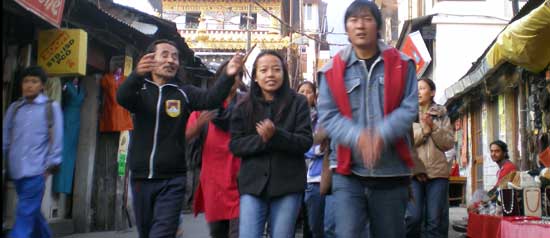
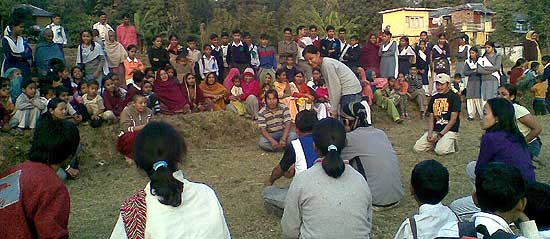
Jaya Iyer is one of the few Indians who trained directly under Augusto Boal, and has been spreading these skills in many communities in India through similar workshops. This was the first time she conducted one in Dharamshala. In the first two days the participants were divided into groups to think of a problem, its cause and its effects. This brainstorming became the base for the four short plays that were performed by the end of the week. So, the students themselves created the plays, in which they contributed with all their earnest hard work. During the five-day training course, the participants created several plays, performed them in front of three different audiences, and thus, collected valuable feedback on how to use the skills they had just learnt, all the while experimenting new techniques. The first performance was in a village in Garoh, where the group told the families in the village that smoking was a ticket to the "Shamshan Ghat" (graveyard), and that a village like theirs was getting destroyed in Tibet, because of mining. The feedback session from this equipped the participants with knowledge about the mistakes they made, which helped them perform in the Yongling School in McLeod Ganj the next day. As Dhondup,a student of the Institute of Buddhist Dialectics later said, "I realised that we had taken the first steps in theatre, and how challenging it is to make a good play." In McLeod Ganj, the plays took a different format, called the Forum Theatre, in which the play freezes at a crucial moment, and the audience is invited to take it the way they want. The themes were of Tibetans not being able to speak in front of Indians and westerners about the issue, and why young Tibetans are not coming out to protest in rallies and marches. Though, initially hesitant, the audience warmed up to the concept. This was an entirely new experience for McLeod Ganj, starting from the fact that a group of excited people were singing in the streets asking for them to come to watch a play. The final performance was in the Jamyang Choeling Nunnery next to the farmhouse in Garoh, where the workshop was held. The nuns participated in the plays and expressed their wish to make a play themselves. Every participant of the workshop had begun to articulate themselves. Their hesitation with languages other than Tibetan reduced, and they were far more confident in expressing their opinion and make their contribution in building their group theatre. The thirty participants were all young Tibetans. Fourteen of them are students from the Sarah Buddhist Monastery of which six were girls, with two nuns, and four from Thangtong Lughar, a group of Tibetan Performing Arts. The others were from McLeod Ganj, two of whom are from McLeod Ganj based Aku Tonpa Theatre Group. Alexandra Weaverling, an American student researching theatre in India, and Chandani Goel, a law student from Hyderabad and this reporter were the non-Tibetans in the workshop. In all, the participants were equipped with "problem-solving theatre" as Ani Choezin Dolma said. The Foundation for the Universal Responsibility of His Holiness the Dalai Lama has actively supported this earnest first step to introducing peoples' theatre to the Tibetan community in exile. It is now encouraging the young theatre aspirants to put together a play and perform it in Delhi and they would find the space and support them where needed. . . . . . . . . . . . . . . . . . . . . . . . . . . . . . . . .
Tibetans to Take Theatre Route Against China After protests and rallies, Tibetans are now taking to theatre to express their "frustration" with China, taking inspiration from the concept of Augusto Boal's 'Theatre of the Oppressed', an interactive form of performance which involves audience participation. "We do not have to shout our lungs all the time, we can act and demonstrate our pain and give voice to our frustration through drama. Sometimes, we can just come out into the streets and laugh at China's paranoia and fear of a Buddhist monk," Tibetan activist Tenzin Tsundue said. 'Friends of Tibet' is organising a five-day workshop from Monday at Garoh, seven kilometres from Dharamshala in Himachal Pradesh to realise this dream and two prominent theatre activists, Jaya Aiyer and Ishtiaq will lend their support in the endeavour. The workshop, which would also train some Indian youngsters, would focus on voice modulation, body language, sense of space and a whole gamut of theatre languages and mechanics. "This would be for the first time the 'Theatre of the Oppressed' would come to Dharamshala. We plan to form a core group of actors who would travel around various parts of the country to convey our situation," Tsundue told PTI. Tsundue said they chose 'Theatre of the Oppressed' as it is an interactive mechanism in which there is audience participation. "The actors are not the only ones who perform. There is a continuous dialogue with the audience in the course of the play. So nobody remains a passive watcher," he said. Besides, this method does not even require a proper stage and infrastructure requisite for the theatrical performances. "It can be performed on a street, in a bus and wherever some people are gathered," he said. . . . . . . . . . . . . . . . . . . . . . . . . . . . . . . . .
Friends of Tibet, PO Box 16674, Bombay 400050, India.
Friends of Tibet is a people's movement to keep alive the issue of
Tibet through direct action. Our activities are aimed at ending China's
occupation of Tibet and the suffering of the Tibetan people. Friends of
Tibet supports the continued struggle of the Tibetan people for
independence.
|