|
The Dalai Lama's Men
In 1995, Sethu Das, son of the illustrious Malayali cartoonist, Yesudasan, went on a holiday to Jammu. From there, he decided to go to Srinagar. On the first day, the bus went half way and had to return to Jammu because of a landslide. On the second day, the road was deemed unsafe: a terrorist group had attacked an Army convoy. So, Sethu went to the bus terminus at Pathankot, which is on the border of Jammu and Kashmir, Punjab and Himachal Pradesh. Buses from Pathankot went to all parts of north India. Sethu saw that all the buses were full, except for one bus, which was going to Dharamshala. On a whim, he decided to go there. What Sethu did not know then was that Dharamshala was where the Dalai Lama and the Tibetan Government-in-Exile had its headquarters. So, when Sethu landed up at the town, he was intrigued to see monks and nuns in saffron robes walking around. He enquired and was told that these innocent-looking people were political prisoners who had escaped from Tibet because of brutal Chinese oppression. "It was an eye-opener for me that such a horrible situation existed in Tibet," says Sethu. What further stunned him was the revelation that nearly all of them had been tortured in Chinese prisons.
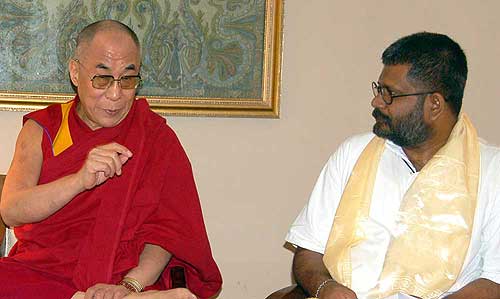
Sethu Das, Founder President of Friends of Tibet (India) with His Holiness the XIV Dalai Lama of Tibet. (Photo: Bertie Dsouza) "One monk showed me his right hand," says Sethu. "Two fingers had been chopped off." Then, there was the tall and well-built Reting Tempa Tsering, 70. He had spent years in Chinese jails and was shot at while escaping to India. "The bullet was lodged in his back," says Sethu. Despite the urging of the Dalai Lama to remove it through surgery, Tsering refused. He said he wanted the bullet to be a symbol of Chinese torture. Meanwhile, shocked at his ignorance of the Tibetan tragedy, Sethu began interacting with the members of Gu-Chu-Sum, an association of former political prisoners from Tibet. He collected books and videos on the subject and started helping out by sending donations from Mumbai, where he worked as a designer. In 1999, he came up with the idea of a web site: Friends of Tibet. The first member was his younger brother, Suku, 34, who lives in Kochi and works as an architect. Later, it became a full-fledged Tibet Support Group. "In India today, there are 3,900 members, with 21 chapters, while international chapters in Uruguay, Pakistan, Nepal, Spain, Sri Lanka and the United Kingdom have been set up," says Sethu.
Suku Dass (Centre) with Dr Ramu Manivannan and others during a workshop at Vellore. (Photo: Buddha Smiles) In Kochi, the Friends of Tibet office at Changampuzha Nagar, which is run by Suku, is small and cosy: there are low sofas, a blackboard on a wall, and various posters on Tibet, one of which has this line: 'China, Get Out of Tibet'. "We are trying to bring an awareness of Tibet to the people here by distributing leaflets, having public meetings and launching campaigns," says Suku. The latest campaign is called 'The World with Tibet'. These are postcards which show the map of the world, but with one crucial difference: Tibet is shown as an independent country. Asked about the reaction of Kochiites to the Tibet issue, Suku says that there are differing responses. Those who are aware of China's overwhelming military control of the country, say, "Why are you fighting for a lost cause?" Another group questions the need to fight on behalf of foreigners, when there are so many causes within the country that need support. "As long as Tibetans remain in India, and are unable to go back, we will fight for their rights," says Suku.
VJ Jose (Right) with Sethu Das during a campaign at Cochin, Kerala. (Photo: Kashi Art Cafe) One of those fighting for their rights in Kochi is activist, V.J. Jose, 52. Every month, he conducts meetings, where he shows films about China's oppression of Tibet and gives talks explaining the history and the background of the country. "After seeing the films, young people express shock at what is happening in Tibet," he says. If you check out the web site (www.friendsoftibet.org), you will see gruesome photographs of executions of Tibetan activists by Chinese soldiers. In one, the head of a young Tibetan woman has been blown off by a gun blast. The people are in agony and as their culture and way of life are being destroyed by the Chinese, Tibetans are fleeing the country. Nearly all of them find refuge in India and there are a few families in Kochi, as well. "There are 1.3 lakh Tibetans in India living in 54 settlements," says the Mumbai-based Sethu. "They are hoping to return to a free and independent Tibet one day." Although this seems like an impossible dream, the Das brothers continue to fight for the Tibetan cause in Kochi and in several parts of India trying to bring an awareness about a country which, for many people, is just a name on a map. . . . . . . . . . . . . . . . . . . . . . . . . . . . . . . . .
Friends of Tibet, PO Box 16674, Bombay 400050, India.
Friends of Tibet is a people's movement to keep alive the issue of
Tibet through direct action. Our activities are aimed at ending China's
occupation of Tibet and the suffering of the Tibetan people. Friends of
Tibet supports the continued struggle of the Tibetan people for
independence.
|