|

The Kerala Connection
(Dharamshala, Himachal Pradesh | September 25, 2006)

Students from southern state of Kerela Karma Yeshi, MP and Editor of Voice of Tibet Radio
Dharamshala, Himachal Pradesh: From the deepest end of India, Kerela came 28 Indian students to Dharamsala, crossing more than 2,000 km, for a two-day workshop on Tibetan issue and left this evening with memories of Dharamsala in rains. In its regular outreach programme, Friends of Tibet (India) organised this two-day camp with support from Indo-Tibet Coordination Office.
The workshop participants are the Final year students of Master in Social Works, Rajgiri College of Cochin. The students are mostly the natives of Kerela except for some who hale from Assam.
The educated Indians now take a new interest in the Tibetan issue partly with the passion as many educated youngsters today take up cases of social and political justice, but mainly because, the Indians believe that only a free and independent country, can guarantee a safe and secure future on its huge Himalayan border.
But this team explained that they were inspired by the nature of the Tibetan struggle which they learned about from some films on Tibet they saw at their college during a Tibet awareness programme organised by Friends of Tibet (Cochin). And while being here in Dharamsala, the students took lessons on Tibetan religion, culture, history, politics, medicine and astrology.
On the first day General Secretary of Friends of Tibet (India) Tenzin Tsundue welcomed the south Indian students to Dharamsala, and after giving a brief introduction to the different programmes arranged for them, he gave a broad introduction to the Tibetan issue from the beginning of its civilisation to the present socio-political situation. He remarked that the origination of the present Tibetan political problem was the invasion of Tibet by People's Republic of China in 1949.
The sessions actually began with the Lhasang Tsering talking about "History of Tibetan Freedom Struggle". The former Tibetan Youth Congress president's passionate and animated lecture commanded a rapt attention from the young Indian audience. They were deeply moved by his stories of struggle as a young man as Lhasang illustrated the story of the Tibetan freedom movement with anecdotes from his own eventful life experiences as an activist.
While fielding questions from the college students his logical, down-right practical ideas, comments and opinions on the present situation won him many rounds of applause from the audience. When asked for his ideas for future course of action, he proposed what he called "strategy of the mosquito", where he gave an example of a armed and strong man like Terminator hero "Arnold Schwarzenegger", and said all the muscles and sophisticated weapons of Arnold would be of no use against mosquitoes who are making him go mad with their stings.
Just then, one student asked him the most dreaded question, after ‘strategic attacks' on China, "what if the international community charges you of terrorism?" There he said: "I have never heard of a cornered mouse terrorising the hungry cat?" and wound up his two hours presentation by saying "finally I have to say that our struggle is not about viability, it's about right and wrong. For us our struggle is a fight for survival, there is no luxury of choice that people would leave it or take it up for its possibility of success. A terrible wrong and injustice has been done to us, and it's our moral duty to fight for the independence of Tibet".
The afternoon session had Geshe Pema Dorjee la giving a talk "An Introduction to the Tibetan Religion and Culture". As an expert that he is in dialectics, Rev Pema Dorjee la ran a long session by asking questions and answering queries ranging from basics of Buddhism to higher philosophies of emptiness and issues of morality for social workers.
Later in the evening, the Indian students were more than excited to meet ex-political prisoners at the Gu-Chu-Sum office. A girl student said "forget about torture by such fiercesom weapons in prison, I have never seen a prison in my life". They met Phuntsok Wangchuk, an ex-political prisoner who spent more almost five years in Drapchi prison and suffered many years of torture along with famed Tanak Jigme Sangpo. Phuntsok explained to them the present situation in Tibet today.
The second day started with Member of Parliament Karma Yeshi introducing the students to the structure of the exile government and functionaries of its various departments and independent bodies. The Voice of Tibet Radio service editor also took the students to his office and explained how it functions as an important bridge between the Tibetans inside and outside Tibet as direct a media link between the two Tibetan worlds. On the fourth Saturday, theirs was the only office working; the Indians expressed surprise on the fact that the Tibetan Government in Exile was enjoying holiday on a fourth Saturday as it's not the case in Kerela.
Dr Tenzin Namdol and Tenzin Sherab took in turns to introduce to the south Indian students the basics of Tibetan Medicine and Astrology. Dr. Namdol by way of example also studied the pulse of two students and advised them on health matters individually. Sherab's talk on Tibetan astrology that can make predictions on universal happenings to specifics like events in individual lives drew much attention from the young people.
Just before they left, they met and had a general discussion with a group of Tibetan youngsters of different background; some are employees of the exile government, while some work with NGOs and others volunteer with Students for a Free Tibet. Tenzin Choeying, the president of SFT India hosted the youth meet leading the discussion touching varieties of issues challenging youth today ranging from issues of moralities in social work to more personal responses to different events that touch our lives like effects of media and fashionable trends. Kerela students' group leader Aparna said that the trip was eye opening and she said she would organise more such trips for other Kerela students.
The Delhi chapter of Friends of Tibet had earlier organised such a trip for a mall group of Indian students from Delhi University last June, another team is being organised for a four-day camp in October in Dharamsala. Camp co-coordinator Amrita, a final BA student says there are many excited Indian students registering with her.
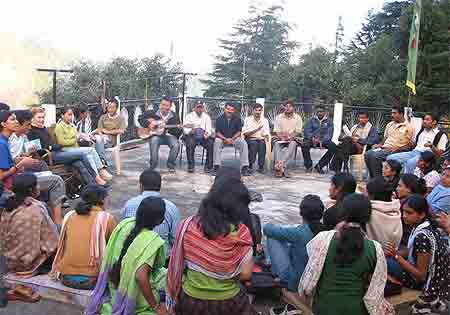
Rajagiri Students singing a solidarity song with Tibetan youngsters at Dharamshala
Students Outreach Programme was organised by Friends of Tibet (Dharamshala) in association with India-Tibet Coordination Office, New Delhi with students from the Rajagiri College of Social Sciences, Kalamassery, Kerala from September 23, 2006.
|