|
New Delhi, Sept 13,
2007:
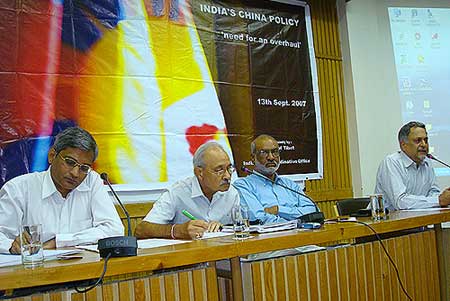
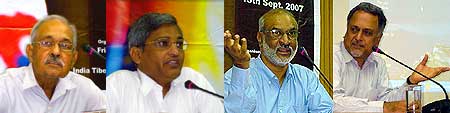
Dr Srikanth Kondapalli (Associate Professor, Chinese Studies, Jawaharlal Nehru University, New Delhi); Dr LL Mehrotra (Former Secretary, Ministry of External Affairs); Dr Mohan Guruswamy (Chairman, Centre for Policy Alternatives Society, New Delhi) and Prof Bharat Karnad (Research Professor, National Security Studies, Centre for Policy Research, New Delhi) during "India's China Policy: Need For An Overhaul" - a panel discussion jointly organised by Friends of Tibet and India Tibet Coordination Office at the India International Centre, New Delhi on September 13, 2007. (Photo: Phayul)
. . . . . . . . . . . . . . . . . . . . . . . . . . . . .
. . .
Panelists: Dr LL Mehrotra (Former Secretary, Ministry of External Affairs)
LL Mehrotra: Retired as Secretary in the Ministry of External Affairs, Government of India, LL Mehrotra studied Tibetan at the institute of Tibetology, Gangtok in 1959-60. His association with His Holiness the Dalai Lama since 1961-62 where he served as a Liaison Officer was the beginning of a closer interest India-China-Tibet affairs. As director of Northern Division of the Ministry of External Affairs, he dealt with the border region of India, during 1969-73. Later he served as Charge d'Affairs in Peking from 1993-95. Mehrotra served in many countries like USA, former USSR, China, Argentina, Mexico, Cuba, Yugoslavia and Sri Lanka. His academic and intellectual pursuits continued even after his retirement as it is evident from the award of Jawaharlal Nehru Fellowship (1993-95) to work on regional cooperation in south Asia. He was a Visiting Professor at the School of International Studies, JNU, New Delhi and coordinator South Asia with Rajiv Gandhi Foundation. He has also served the Bharatiya Vidya Bhavan, New Delhi as the Director: Overseas and as an Honorary Professor for El Salvador University, Buenos-Aires, Argentina.
Bharat Karnad: Research Professor at National Security Studies, Centre for Policy Research, New Delhi. Formerly he was a member of National Security Advisory Board, National Security Council, especially member of the Nuclear Doctrine Drafting Group and of the external group and the technology Security groups for the Strategic Review. Karnad was also an advisor on Defence Expenditure to the 10th Finance Commission. He has been involved in various 2nd Track dialogues with the US, China, Taiwan, Pakistan and Israel. He has been invited to give talks among other places at the Brookings Institution and the US State Department, Washington DC, and the Institute of Defense and Strategic Studies, Singapore. Prominent publications include 'Nuclear Weapons and Indian Security: The Realist Foundations of Strategy, 2005, and 'Future Imperilled: India's Security in the 1990s and Beyond'.
Dr Srikanth Kondapalli: Associate Professor in Chinese Studies at Jawaharlal Nehru University, Dr Kondapalli is also an Honorary Fellow at Institute of Chinese Studies, Delhi and Research Associate at Centre for Chinese Studies at University of Stellenbosch, South Africa. He served at the Institute of Defence Studies and Analysis, New Delhi for nearly 12 years. He has specialised in Chinese Studies, learned Chinese language at Beijing Language and Culture University and was a post Doctoral Visiting Fellow at People's University, Beijing from 1996-98. He was a Visiting Professor at National Chengchi University, Taipei in 2004 and a visiting Fellow at China Institute for Contemporary International Relations, Beijing in 2007. He is a Guest Faculty member at Indo-Tibetan Border Police Academy and Border Security Force Academy. His major works include 'A Great Leap Forward Modernisation: China's Armed Forces in 2003'. He has conducted training courses for Indian officials in aspects of Indian security.
Dr Mohan Guruswamy: Graduate from the Indian Institute of Management, Ahmedabad. He went on to study at the John Kennedy School of Governance, University of Harvard, Fletcher School of Law and Diplomacy, Graduate School of Business, Stanford. With 25 years of experience in academia, on industry and government, Guruswamy has authored four books on International Affairs and Economic Issues. He has been a part of many international conferences, such as China Economic Society Conference held in Shanghai in 2005. Presently he heads the Centre for Policy Alternatives, New Delhi.
. . . . . . . . . . . . . . . . . . . . . . . . . . . . . . . .
"India's China Policy: Need For An Overhaul"
Dr LL Mehrotra (Former Secretary, Ministry of External Affairs); Dr Srikanth Kondapalli (Associate Professor, Chinese Studies, Jawaharlal Nehru University, New Delhi); Dr Mohan Guruswamy (Chairman, Centre for Policy Alternatives Society, New Delhi) and Prof Bharat Karnad (Research Professor, National Security Studies, Centre for Policy Research, New Delhi)
. . . . . . . . . . . . . . . . . . . . . . . . . . . . . . . .
(Proposed “Welcome Address” which the writer CA Kallianpur, National Coordinator of Friends of Tibet (India) would have given in the normal circumstances at the India International Centre, New Delhi on September 13, 2007 during the panel discussion “India’s China Policy – Need for An Overhaul” but could not as the writer never reached New Delhi. On September 12, 2007, CA Kallianpur was drugged on a train and later found unconscious at Mathura railway station in Uttar Pradesh. He was admitted to the Mathura District Hospital by the Government Railway Police from September 12-16, 2007. The writer can be contacted at: ca.kallianpur@friendsoftibet.org)
We welcome you all to a discussion of a profound topic "India's China Policy – Need for An Overhaul".
We felt the need for such a panel discussion as it struck us that groups who are very vocal when it comes to western colonialism are unusually silent when it comes to eastern especially Chinese colonialism and attempt to confuse by linking it to unconnected issues. As a result of which China has escaped the scanner and even sixty years after the formation of the United Nations there are large parts in Asia that do not have freedom and there still remain many remnants of colonial rule in need of decolonisation like Tibet, Manchuria, Inner i.e. Southern Mongolia, Eastern Turkestan, Yunnan and Guangxi-Zhuang. This silence has to be shattered if India has to come to grips with the real issue and not go around in circles.
I am reminded of a small incident that happened in Dharamshala. I was in Dharamshala for about six months in 2003. At the Library they normally invite scholars to give talks and one such invitee was Dr. Alex Mckay from London University’s School of Oriental and African Studies and now I think with the Wellcome Foundation who has come out with virtually an encyclopaedia on Tibet, unfortunately in his talk he was trying to minimise Britain’s role in the Tibetan tragedy in the first decade of the previous century. During the Question and Answer session I had to tell Dr. McKay that things were not so cut and dried as he has made out. After the session we met personally and I introduced myself. His first question to me was about Dr. Alastair Lamb! I told him frankly that Dr. Alastair Lamb started out as a promising academic but that today he is just a lobbyist, no one takes him seriously. When I mentioned that he laughed and said "Yes" and added "What with the Pakistani Embassy sending him their staff car!" The point I am trying to make Ladies and Gentlemen is that a whole generation in India has swallowed hook, line & sinker Neville Maxwell’s “India’s China War” based largely on Dr. Alastair Lamb’s early works as if it is final and binding.
No wonder in spite of overwhelming new evidence surfacing about the political status of Tibet, India continues to wallow in old thinking. One Editor-in-Chief of a so-called national daily from the south talks about Greater Tibet but does not talk of Greater China which even a Chinese academic talks and warns about. Another regular contributor to the Indian Express says that India should not antagonise China but does not mind China antagonising us. This gentleman does not even know what constitutes actual China and what constitutes minority areas it rules which are virtually nations. The late Chinese Prime Minister, Mr. Chou-en-lai is reported to have said that Indians are “useful idiots”. It looks like this country is crawling with them.
Gandhi had given his entire life to get rid of and not preserve western colonialism. Gandhi’s successors should not end up legitimising eastern especially Chinese colonialism.
To discuss this profound topic today, we have a very eminent panel. I now ask Ms. Tarini Mehta to read out the profiles of the Chairperson and panelists as per schedule.
Thank you.
. . . . . . . . . . . . . . . . . . . . . . . . . . . . . . . .
New Delhi: Friends of Tibet in association with India-Tibet Coordination Office organised a panel discussion on "India's China Policy: Need For An Overhaul" at the India International Centre, New Delhi on September 13, 2007. As Dr LL Mehrotra, former secretary to the Ministry of External affairs, Government of India, commented while declaring the seminar open, the discussion was not just crucial and timely, but very well thought out. "Policy cannot move along a beaten track. But, it needs a thorough study to determine the need for change and the degree of change needed- from both strategic and tactical view points."
Mehrotra stated that both countries have lived 50 years in the post-colonial era, which has seen seismic changes, the first was the Shanghai's Communiqué of 1972, welcomed by the People's Republic of China as the God of the future. In 1976, when Mehrotra was Charge-de-Affairs, Peking, the agreement to exchange ambassadors again (which was stopped since 1962) was signed. This change of relations came in the context of the birth of a new nation, Bangladesh in 1975.
The second seismic change came two decades after the communiqué, and partly as consequence, since the break up of the Soviet Union, China has moved even closer to the US, even on nuclear cooperation, while we are still grappling with the political fallouts of an agreement in its embryonic stages. According to him, we have mended our fences with China to some extent, to maintain peace and tranquility on the border. However, Chinese, still treat the border as undefined, large chunks of it remain under Chinese control, and they openly declare India's state of Arunachal Pradesh. While speaking of forging a strategic relationship with India, many of its actions run counter to India's strategic interests and pose a great challenge to its security. It unabashedly uses India's differences with her neighbors to add to its own strategic fortunes in south Asia; a region of our immediate and direct security concern. It has secured rights to set up strategic facilities, at the most sensitive security points, in Pakistan, Myanmar, Bangladesh and Sri Lanka. It has helped Pakistan emerge as a nuclear weaponised country.
Meanwhile, Tibet remains the hub of nuclear research centres and its nuclear arsenals, which threaten every part of India. The environment damage to Tibet hurts India since Tibet is the largest reservoir of all the water supply to all the major river systems of North India. Before leaving the floor open for the other speakers, he briefly commented on the recent statement that the next Dalai Lama would have to be born in China. "Purely on religious grounds, one may ask them, who can ask his soul, any soul for that matter, to be reborn in a region."
Dr Bharat Karnad, Research Professor in National Security Studies, started by extrapolating on the nuclear deal with the United States. "The only apprehension in the county about the nuclear deal is that it envisages a relationship of an unequal type, which is not there in the case of United States and China, primarily because they are nuclear weaponised, Nuclear Proliferation Treaty (NPT) recognised states. He observed that China is driven by hard real-politic. The fact of the matter is, it is not in China's interest to have India, or any other powerful Asian nation in the United States Security Council. Juxtapose that to what happened in 1955-57, when John Foster Dulles, Secretary of State, United States, actually offered India a seat in the UNSC and Nehru rejected it, on the plea that China deserved it better.
When the erstwhile Soviet Union disintegrated virtually overnight, none of the think tanks and analysts predicted such a cataclysmic event, except one man, Milan Howler. His thesis, according to Bharat Karnad, applicable to China too. It says that USSR was torn apart by the thrust of the East and West on its imperial axis, meaning that Russia expanded eastward into the Pacific and the European Atlantic Region. So that created a tension. It is also torn apart by tensions on north and south axis- the rich North and the Poor South.
Karnad transposed the theory onto China and explained that China too shows symptoms of disintegration along the same lines.
The next question he asks is whether India is in a position to withstand the collapse, when it happens. In 1949, Nehru chose to ignore the PLA's increasing presence in Tibet, because he concluded that India did not have the wherewithal to do anything about it. Nehru received repeated warnings of building up army on the Tibetan front from Gen Verma in 1953, Gen Dohraj in 1958, but continued to believe that the colonial army would not be able to stand up against the PLA. 1962 was a disaster. It resulted in China's moral ascendancy over India.
But, as of now, Karnad explained how in terms of conventional military, China was lagging behind India, especially in the naval fleets. For the army, Karnad suggested an increase in facilities, which transfer large armed troops at a time, something China has specialised. In the strategic realm, however, China enjoyed a clear edge over us - India is being a hesitant nuclear power, and has not allowed its scientists in trying their promising designs. That is where the nuclear deal with US comes in - US does not want us to test. He concluded with, "Ultimately the deterrence and nuclear tests are mind games. India has not ever worked well in crises. Hence, we need to build our nuclear wherewithal so that no country can intimidate us."
Dr Srikanth Kondapalli, Associate Professor in the Institute of East Asian Studies, Jawaharlal Nehru University, New Delhi began his talk by observing the fact that a Ladakhi Tibetan refugee camp recoded a turn out for matriculate exams, which was comparable to Delhi schools. "This is good news," he said, "not just for the Tibetans, but Indians too. Any community that does not promote talent is doomed. A knowledge economy is necessary if you want to graduate into the twenty first century. So, you have displayed that you have the talent, by going ahead with this programme."
The Ministry of External Affairs Annual reports 2001, 2002 and 2003 indicate what the basic principles of foreign policy are: six main aspects - preserving sovereign independence, maintaining freedom of judgement, internal peace, and stability, reduce world tensions, and fashion a more equitable world order, conquering terrorism, and promoting democracy.
Thus, promoting democracy was not the guiding factor for India's foreign policy. It is confined to immediate neighborhood - in terms of Pakistan, Bangladesh, Nepal and Sri Lanka. India ahs not supported the Fiji Prime minister, Chowdhury, when deposed in a coup.
Kondapalli counted seven major actors who inform India's Foreign Policy with respect to China: national sentiment, the Ministry of External Affairs, from the 1970 is the Prime Minister’s office, China study group giving policy suggestions, on a short, medium, and long-term basis, the Ministry of Defence, the Ministry of Home Affairs, and increasingly, ASSOCHAM, FICCI and CII (business and industrial lobby groups). The civil society - the press, academics, you, and I also inform policy making.
According to a Chinese military magazine in the '80s, in 1989, the kill ratio on the India-China border was 1:10 ie. for every one Indian soldier killed in battle, ten Chinese soldiers killed. We have a relative conventional superiority vis-à-vis the Chinese PLA. In 1998, Goerge Fernandes, the then Defence Minister, said China was the number one potential threat to India. He changed that position when he visited Beijing in March 2003. Never the less, the Defence Ministry still sports that view of China as long-term challenge. This change of position also comes in the context of controlled normalisation between India and China; and, we have the stated industrial groups as actors. Not overwhelming, but 25 billion dollars of trade shows its marked presence. But the unfavorable Balance of Trade shows that we are losing more money than Chinese are gaining.
China has imposed three conditions for normalisation:
The response of the Indian Foreign Policy is that the press is not under the control of the government. So, the third condition is still to meet with success. The political Parties - Congress, BJP, Janata Dal, Samata Dal, CPI, CPM - the Communist Party of China sends delegations to all these parties, including RSS and the VHP. They are invited to China to interact with the Communist Party leaders.
For any foreign policy, five major options become available: engagement, status quo, balance of power, containment policy, building, and promoting democracies. Rajiv Gandhi stated that the Tiananmen Square incident is an internal matter for China. It is not about the students, workers, and peasants. So, democracy has been relegated as a foreign policy option. The engagement policy has been dominant in the '50s and the '90s. This has reflected towards Tibet and Taiwan too.
For Tibet, India ahs three policy options:
In 1954, Nehru stated Tibet to be part of China - informed of the ground realities that the PLA marched into Tibet, and there is an overwhelming PLA presence.
In 1988, we added the word 'autonomy' in terms of Tibet policy.
In 2003, pressure from China to include word ‘inalienable’ in the bilateral agreement between Vajpayee and Wen Jiabao, it finally made its way in, but we saw an internal rift in BJP and the Parliament rocked on June 21, 2003.
1950s were the time of multilateralism between India and China, in terms of Afro-Asian Unity (Bandung Conference and Panchsheel). Currently, too, we see shades of engagement, in terms of China joining SAARC, on April 14 this year in New Delhi. Indian Candidature in terms of Shanghai Cooperation Summit and the East Asian Summit, December 2005. Multilateralism is also reflected in the World Trade Organisation talks and in the Kyoto Protocol Talks. Diplomatic normalisation started from 1976 when KR Narayanan signed the agreement. In Kondapalli's view, diplomatic normalisation has not transformed into complete normalisation- never are these relations normal, nor abnormal.
The Indo-Japan Treaty, singed by Manmohan Singh when he visited Tokyo, led to military cooperation between two countries. The Joint Declaration between Wen Jiabao and Manmohan Singh mentioned expanding military exchanges. In other words, "I'll visit and that's it." We should hope to see more defence exercises happening, as Pranab Mukherjee visited China last year and completed the MoU of defence exercises.
Next month, Indian army is going to Chengdu military region, to conduct a low-level joint operation, with Chinese military. All these have been controlled in a way that normalisation is not exactly flowering between the two countries. Each one has trust deficit between the two countries - both do not have equal status vis-à-vis each other.
Political visits are limited - Indian PM visits ten years after the last one. Engagement policy has seen increase in trade, but border trade has been less - 100 million dollars compared to 25 million dollars overall trade. Partly because of the Indian fear that more trade with China meant dumping of Chinese goods in Indian markets. Because the Chinese are reluctant in discussing border issues with India, no point having free trade zone then. We must anticipate a regional trade agreement in the pipeline.
Cultural exchange another aspect of the engagement policy. Cooperation with respect to space programmes, CBMs in 1996. Mani Shankar Aiyar signed a MoU on energy cooperation, two years ago, two MoU's on Brahmaputra water sharing.
Between 1962-88, Status Quo was the dominant policy option. No momentum forward on border issues. Also reflected in controlled opposition and initiatives on multilateral issues. However, status quo is not a viable option when two countries are rising and in Asia, three countries are rising - India, China and Japan. That meant there are quite a number of issues on which India needs to take a stand.
The third policy option is reflected in shades again - the Balance of Power positions. In 22-05-07, People's Daily, a Chinese newspaper had articles criticising India's role in candidature in East Asian Summit. Overall, it appeared that China's balance of power position was more successful than India's. The 1971 and 1998 agreements between Zhang Zemin and President Clinton reflected that China has been more successful in containing India than India has been in containing China.
The fourth position is of containing China - is it possible/viable? We can see shades of that in the military establishment in the thesis on China’s threat, it has been withdrawn, but it is present as a latent aspect in all military preparations. Agni-3 successful this year, failed last year, part of that containment of China.
Second part of containment is strategic self-involvement. The string of pearls council, insurrected in January 2006, talked about from 1986: as Chinese Navy visits Karachi, Colombo, as counter-strategic encirclement India champions relations with Mongolia, Vietnam: every other country with adversarial relations with China. For example, Indian Ambassador to Olan Bator was a Buddhist Lama, who was more popular than the Mongolian President himself was. Mongolia was a nuclear weapon free zone, so there is no chance of any Indian traverse in strategic weapons programme. But, with Vietnam, India fears it turning nuclear.
In 2005, India held naval exercises with Vietnam - in the South China Sea: a contested area between China and other ASEAN countries. China voiced its concerns, and India stayed off. Recently, India held a joint naval exercise, but this time, with all the rest of the ASEAN countries.
The Indian military policy is "deterring Pakistan, dissuading China." In some time, depending on local reactions, it will be "deterring Pakistan and deterring China." If you do not have an Agni-3 in place, oprationalised, the Indian Air Force on the border, do not have the Rapid Response Force on the border, no point in deterring China. That transition form deterring China to dissuading China is the next 15-20 years. At the subterranean level, policy is changing.
There is a huge asymmetry between power relations between India and China. They have outsmarted us in everyway - in hard and soft power, reflected in economic growth rate and trade, military, conventional, and strategic: that asymmetry in comprehensive national strength is reflected in the overall bilateral relations between two countries. China Institute of International Studies estimated that China is atleast six, in the global rank of power from 1 to 10. India is at eight, though it was pushed forward from nine.
This means the incongruence is reflected in other relations, including Tibet.
The next 15-20 years will also see negotiations, based on reciprocity. For example, no move to push for India in the UNSC is forthcoming. So, foreign policy will remain minimalist: sovereignty and territorial disputes (in relation to border issues, and other related issues).
Dr Mohan Guruswamy described his visit to China for a talk titled, "the dragon, and the elephant" and he observed that the dragon was a myth and the elephant was real. He stated that India's policy with respect to China was indeed rather "creaky, like everything else in India", but does it amount to a total collapse of the overall foreign policy? No. So, China still remains peripheral to India's main aim - get our economy going. India has always had a supine policy towards China.
He commented on Tibet being "squashed" between the bigger nation states who are following their own interests. But, India has always made in clear that China cannot come below the Himalayan belt. He observed that the MiGs had been removed from Tezpur (Assam), to give way to Sukhoi's, which told the Chinese, to stay-off Arunachal Pradesh. India has also raised the budget to the Dalai Lama from 1 to 10 crore. These are signals to the country that neither are the two friends, nor enemies, but somewhere in between.
. . . . . . . . . . . . . . . . . . . . . . . . . . . . . . . .
Friends of Tibet, PO Box 16674, Bombay 400050, India.
Friends of Tibet is a people's movement to keep alive the issue of
Tibet through direct action. Our activities are aimed at ending China's
occupation of Tibet and the suffering of the Tibetan people. Friends of
Tibet supports the continued struggle of the Tibetan people for
independence.
|